
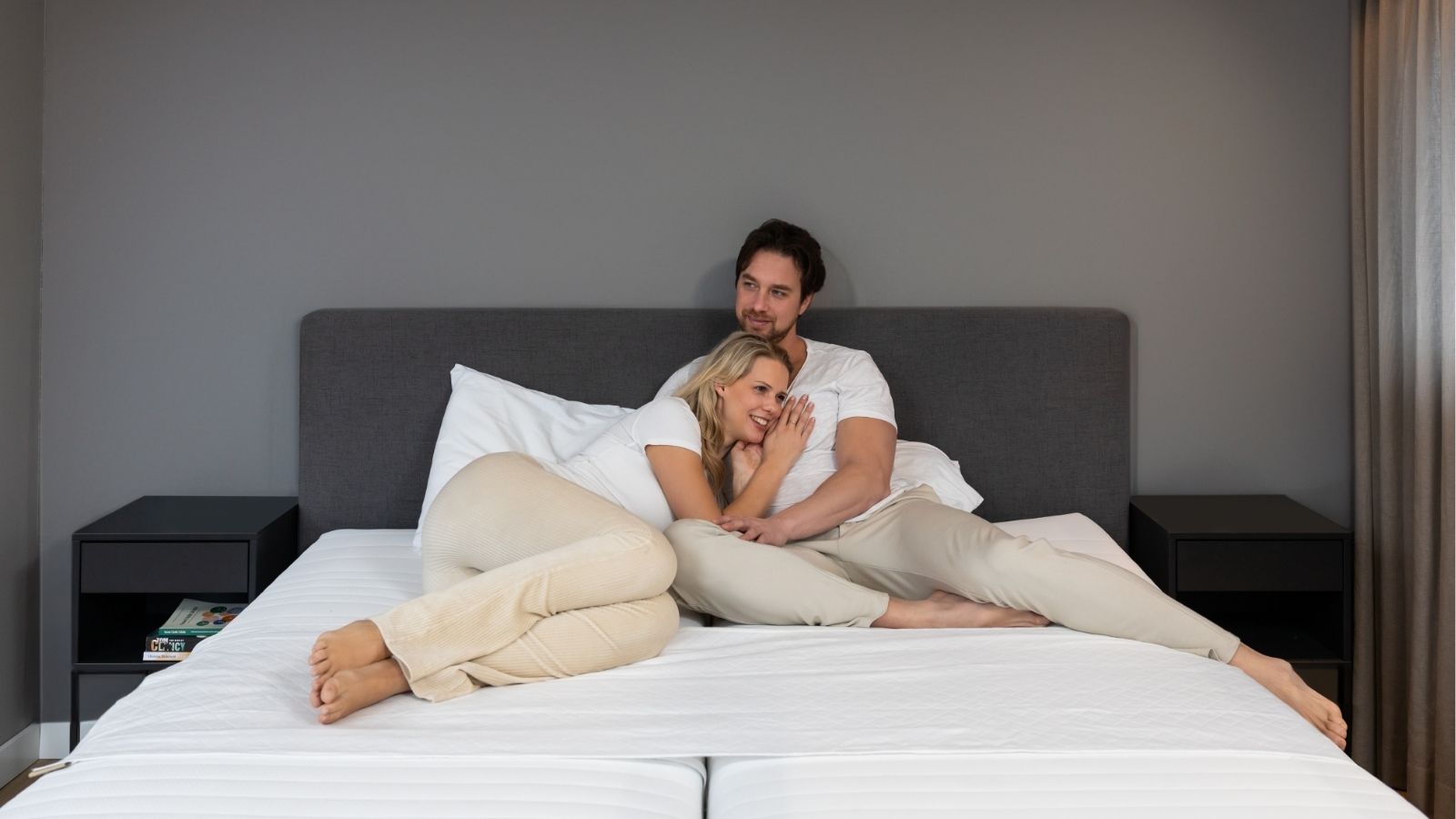
Non-slip mattress pad or a connector:
two problems, not one
Grip and connection sound like the same fix. They are not, and buying the wrong one is the most common mistake in this whole category.
What does a non-slip mattress pad do?
A non slip mattress pad adds friction between the mattress and the base underneath it. That fixes exactly one problem:
- One mattress travelling on its base. Metal frames, painted slats and box springs are smooth. A pad gives the mattress something to hold. This is what a pad is for, and it does it well.
- Two mattresses drifting apart. A pad holds each mattress to the bed. It does not hold one mattress to the other, so the seam still opens.
If your problem is the first, buy the pad. It costs a few dollars and we do not sell one. If it is the second, grip is not the answer, and that is the case the Bedbinder is built for.
Non-slip pad against a connector, honestly
Two products, two jobs. The table is only useful once you know which row applies to you.
| Non-slip mattress pad | Connector band | |
|---|---|---|
| The gap in the middle disappears | No, it fills nothing | Yes, the mattresses stay together |
| The mattresses stop sliding apart | Some grip, but no hold | Yes, that is the mechanism |
| No bump or ridge in the middle | Yes, it lies flat underneath | Yes, the band lies flat under the sheet |
| You feel nothing lying on it | Yes | Yes |
| Stays put, months later too | It shifts along over time | Yes, it stays taut |
| Fits a boxspring 140 to 200 cm | No, poor grip on smooth boxspring fabric | Yes, 80 cm wide with 3 straps |
| Works on an adjustable bed (head end) | No | Yes, place the band slightly lower |
| Machine washable at 30 degrees | Depends on the pad | Yes, 30 degrees |
| Does not damage your sheet or mattress | Yes | Yes, rounded nylon buckles |
Scroll sideways on mobile for the full table.
Which of the two problems do you have?
Look at the bed in the morning, before you straighten anything.
One mattress, sitting crooked
Shifted toward the foot end, hanging over one side, or with bare frame showing at the top. That is a grip problem and a non slip mattress pad is the whole answer. So is a roll of rubber shelf liner, which is the same idea for less money.
Two mattresses, with a seam that widens
Most often a split king or two twins pushed together. Grip will not close that, because there is nothing between the two mattresses for a pad to grip on. They have to be tied to each other.
Both at once
It happens, usually on a slippery metal frame with two mattresses on it. Then the pairing makes sense: a pad under each mattress, a band around both. That is the one case where buying both is not a waste.
The full version of this diagnosis, with the fixes for each, is on how to keep a mattress from sliding.
What to look for in a non-slip mattress pad
We do not sell these, so take this as it is meant: the four things worth checking.
- Fabric-backed rather than bare rubber. Cheap rubberised sheets break down over a few years and can leave residue on the underside of the mattress in a warm room.
- Wide enough to cover the whole base. A strip down the middle grips the middle only, and the corners keep walking.
- Thin. Anything thick enough to feel through the mattress is doing more than you asked of it.
- Cuttable. Rubber shelf liner off a roll costs a fraction of a purpose-made non slip mattress gripper and does most of the same work on a metal frame.
What not to bother with
- A towel or old sheet under the mattress. The fabric slides on the frame just as easily as the mattress did.
- Velcro strips on painted slats. They hold for a few weeks, then peel.
- A pad bought to fix two mattresses parting. That is the wrong tool and it is the most returned combination in this category.
What connecting two mattresses looks like
Only relevant if your problem is the seam rather than the grip. Across the middle, straps underneath, three buckles, about 60 seconds.
4.1/5 from 3,765 reviews · more than 250,000 sold
From people who had the other problem
These are customers whose mattresses were parting rather than slipping, which is the case a pad cannot cover.
Wedges spread the mattresses.
“Great solution. All of the other solutions for combining a bed involve a wedge which inherently spreads mattresses.”
Weird at first, but it works.
“Material is a little stiff and feels weird at first but by far the best solution we have found to our split king bed. We put it under the fitted sheets so they do bunch a little in the middle but it's not noticeable.”
No more valley.
“Holds both sides of my bed together very well. I don't wake up in a valley with my back folded like an accordion anymore. Very unnoticeable as well.”
Questions about non-slip pads
Including the ones where the answer is not our product.
What does a non-slip mattress pad actually do?
It adds friction between the mattress and the base underneath it. A rubberised or textured sheet stops the mattress travelling on a smooth surface such as a metal frame, painted slats or a box spring. It works on the contact between mattress and bed, and on nothing else.
Will a non-slip pad stop two mattresses drifting apart?
No, and this is the one thing worth knowing before you buy. A pad holds each mattress to the base. It does not hold one mattress to the other, so two mattresses on a grippy surface still open a seam in the middle. Grip and connection are different jobs.
Which is cheaper, a pad or a connector?
The pad, by a long way. Rubber shelf liner costs a few dollars and a purpose-made non-slip pad rarely more than twenty. The Bedbinder Deluxe is $57.00. If a pad solves your problem, buying a connector is money spent on the wrong thing.
Can I use rubber shelf liner instead of a proper pad?
Yes, and plenty of people do. A roll of rubber shelf liner cut to the width of the base gives most of the grip for a fraction of the price. It is thinner and will need replacing sooner, but for a metal frame it is the cheapest thing that works.
Do non-slip pads work on an adjustable bed?
Partly. They help a single mattress stay on a base that raises and lowers, which is why the adjustable version of the search exists. What they do not do is stop two halves of a split king pulling away from each other, because there is nothing between the two mattresses to grip.
Can I use both a pad and a connector?
You can, and on a slippery frame with two mattresses it is a sensible pairing: the pad keeps each mattress on its base, the connector keeps the two together. Most people need only one of the two, which is why working out the cause first saves money.
Will a non-slip pad damage my mattress?
A textile-backed pad will not. Some cheap rubberised sheets break down over a few years and leave residue on the underside of the mattress, especially in a warm room. It is cosmetic rather than structural, but it is a reason to buy the fabric type rather than the bare rubber type.
How do I tell which problem I have?
Look at the bed before straightening it. One mattress sitting crooked or hanging off the frame is a grip problem, so buy the pad. Two mattresses with a widening seam down the middle is a connection problem, and no amount of grip closes it.
Does a non-slip mat keep two mattresses together?
No. It stops one mattress sliding on its base, not two mattresses drifting apart.
What is the best non-slip solution to keep mattresses in place?
A non-slip pad stops one mattress sliding on its base. To keep two mattresses together, you need a connector like Bedbinder Deluxe.
The neighbouring questions
Three pages for the cases a pad does not cover.
Grip or connection?
The full diagnosis, with the cheap fixes for the grip half.
Read moreDo retainer bars work?
Brackets and stoppers at the foot of the bed, and where they run out.
Read moreWhen the topper is the thing moving
A sliding topper has two causes, and only one of them is grip.
Read more

A pad, or something that actually joins them?
If the seam in the middle is the problem, grip was never going to close it.
90 nights to try it when you order on bedbinderdeluxe.com. On Amazon, their 30-day return window applies.